Humans, living things, the earth, natural resources—all of these are, relatively speaking, solid. But are they truly solid? Over two thousand years ago, the Greek philosopher Democritus suggested that everything physical, at the most fundamental level, is composed of atoms—hard, solid particles that cannot be deformed or broken into anything smaller; all that exists are atoms and the void—the latter of which is empty space, temporarily unfilled. Democritus supposed the atoms of water were round and smooth, while those of iron rough and jagged—interlocking.
Was Democritus correct? No, no, no. Although matter is composed of what we refer to as atoms, atoms have a complex structure and are composed of even smaller particles (subatomic particles). In truth, the actual arrangement of these subatomic particles completely defies our physical perception of matter.
In 1904—about one hundred years after British chemist John Dalton found real evidence for the existence of atoms, and seven years after British physicist Sir Joseph John Thomson J. J. Thomson) discovered the electron (a negatively charged, subatomic particle)—J. J. Thomson proposed the “plum pudding” model of the atom: negatively charged electrons (like plums, or raisins) inside a sea of positively charged fluid (like a sphere of pudding)—the latter of which contains most of the atom’s mass and just enough positive charge to give the atom zero net charge.
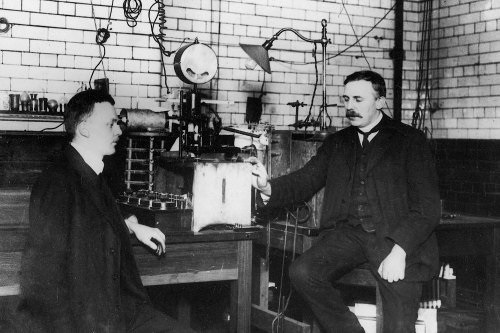
J. J. Thomson’s “plum pudding” model of the atom was the most popular for several years, but in 1911, New Zealand physicist Ernest Rutherford and his student laboratory assistants H. W. Geiger and E. Marsden conducted a magnificent experiment that physically disproved it—an experiment known as the Rutherford scattering experiment.
The idea for this experiment came about through Rutherford’s study of radioactivity. He found that the radioactive decay of uranium gave off at least two types of particles: 𝛼 (alpha) and 𝛽 (beta) (labeled by him). The fast-moving, large-mass, positively charged 𝛼 particles, he determined, would make a great probe for studying the interior of different atoms.
In Rutherford’s scattering experiment, 𝛼 particles from a decaying radioactive material were beamed through an extremely thin sheet of gold foil—a sheet only about 1000–2000 atoms thick. The 𝛼 particles then struck a screen on the other side of the sheet, allowing the experimenters to determine how the gold foil affected the 𝛼 particles’ flight path, if at all.
Rutherford observed that most 𝛼 particles passed through the foil undeflected, while some were deflected to very small angles (to a degree, or a few degrees). This was not too surprising; if the “plum pudding” atomic model was accurate, one would expect the fast-moving, large-mass 𝛼 particles to pass through the gold foil with ease—like BBs through a thin slab of Jell-O—experiencing only minor deflections, at most, due to the weak attractive forces exerted on them by the gold atoms’ electrons.
However, completely unexpected, a few 𝛼 particles were deflected by the gold foil up to 90°—some even more: some struck the foil and were deflected almost straight up, down, or to the side, while others—an incredibly small proportion, but still some—bounced back nearly in the direction from which they came.
If J. J. Thomson’s “plum pudding” model was accurate, it would have been impossible for any 𝛼 particles to be deflected to such extreme angles (similarly, no BBs shot at Jell-O would ever come back at you). Rutherford’s reaction to his experimental finding was as follows:
“It was quite the most incredible event that has ever happened to me in my life. It was almost as incredible as if you fired a 15-inch shell at a piece of tissue paper and it came back and hit you.” — Ernest Rutherford
The only way these fast-moving, large-mass, positively charged 𝛼 particles could have been deflected to such large angles was if they hit something hard and heavy. Since this behavior was observed in so few 𝛼 particles, this hard and heavy thing must occupy very little space in the atom. Rutherford’s experiment thus revealed the existence of the tiny, heavy, positively charged nucleus. Negatively charged electrons orbit the nucleus.
So, if most of the atom’s mass is concentrated in the tiny nucleus and most 𝛼 particles were not deflected, it follows that most 𝛼 particles passed through empty space, experiencing very weak attractive forces from the electrons and rarely more than weak repulsive forces from the nucleus.
Atoms are mostly empty space. How does this make any sense??? If matter is made of atoms, then doesn’t it follow that matter is mostly empty space? Are we, and is all we interact with, mostly empty space? How does anything stay together? Why don’t we fall apart or pass through everything we touch? Unfortunately, said questions await a lengthier discussion.
Question the world around you! Things are not always as they seem.