Robert Schumann was born on June 8th, 1810, in the German Saxon town of Zwickau—the fifth and last child of August Schumann and Johanna Christiana Schumann née Schnabel. His father’s successful bookselling business provided well for their family, and instilled in Robert a lifelong interest in literature. At age seven, after Schumann’s frequent singing made his parents aware of his musical talent, Schumann began taking piano lessons from Johann Gottfried Kuntsch—a local organist. Apart from, at age sixteen, having to cope with the death of his nineteen-year-old sister Emilie and the death of his father just weeks later, Schumann lived a comfortable childhood, nurturing his competing interests in music and literature while attending private school.
Robert Schumann graduated from the Zwickau Lyceum at age eighteen, upon which he moved to Leipzig and enrolled at Leipzig University as a law student to fulfill his mother’s wishes. However, he attended few classes, if any, instead engaging with the city’s music scene and studying piano. Deciding to become a concert pianist, he convinced his mother by letter to support him in a musical career and began a rigorous piano regimen under Friedrich Wieck, who was considered one of the world’s leading pedagogues due to the pianistic success of his nine-year-old daughter, Clara Wieck. Unfortunately, between 1829 and 1832, Schumann ruined his right hand through the use of Johann Bernhard Logier’s ‘Chiroplast’—a supposed hand-strengthening mechanism that Schumann hoped would accelerate his pianistic progress—rendering him unable to continue pursuing a career as a pianist. But only weeks after deeming his hand ‘incurable,’ he decided to fully commit himself to composition instead.
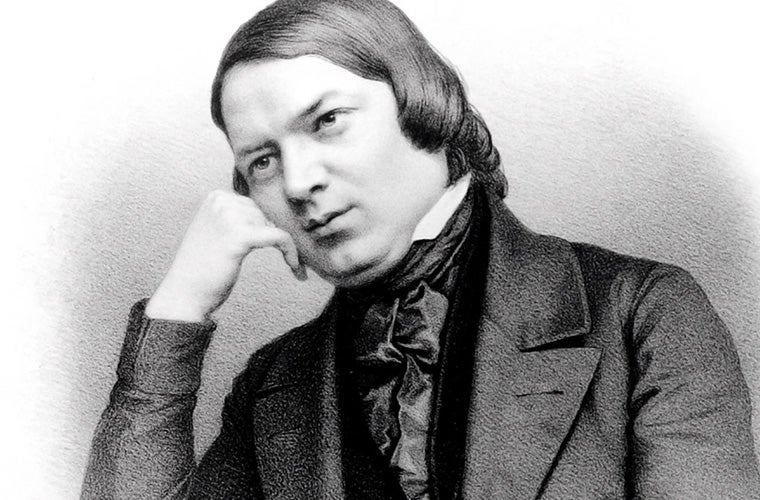
In 1834, alongside his compositional pursuits, Schumann founded the Neue Zeitschrift für Musik (New Newspaper for Music)—a music criticism publication containing articles written by the Davidsbündler (League of David). The Davidsbündler is an imaginary group of artist-characters created by Schumann, named after the biblical King David, who played and composed music, wrote poetry, and slew Goliath—the leader of the Philistines. Each character is based on a real artist. It was the task of the Davidsbündler to oppose the Philistine army of music conservatives and champion new music that did the following: used new forms, based on classical models; subordinated technique and virtuosity to the compositional idea; and conveyed a composer’s personal life experience. Schumann’s music journal promoted the works of many composers and was so successful that, for many years, Schumann was far better known to the outside world as a critic than as a composer. Throughout his relatively short life, Schumann also struggled with depression and other mental disorders, and it was through the Davidsbündler that he enjoyed becoming others, expressing different identities.
In the midst of all this, beginning back when Schumann had begun studying piano with Friedrich Wieck, he had gotten to know Wieck’s daughter—piano virtuosa Clara Wieck—and by the end of 1835, Robert and Clara had declared their love for one another—Robert Schumann aged twenty-five and Clara Wieck aged sixteen. Friedrich Wieck strictly opposed this relationship, for Clara was his life’s work and he maintained that she was to be a concert pianist and not a housewife. For three years, the two fought over Clara, Wieck publicly discrediting Schumann and forbidding Clara from meeting with him. But, after a legal battle, the courts gave Robert and Clara permission to marry, and the wedding ceremony took place on September 12th, 1840.
It was during the fight for Clara when Schumann composed Davidsbündlertänze Op. 6 (Dances of the League of David). After secretly exchanging letters in early August of 1837, breaking eighteen months of silence that had separated them, Robert and Clara formalized their engagement. Creatively inspired by thoughts of love and hope for marriage, Schumann began composing Davidsbündlertänze Op. 6 on August 20th, 1837 and completed a draft in about three weeks. The work consists of eighteen movements, each ‘composed’ by Florestan (the extroverted, impatient, and agitated side of Schumann’s personality), Eusebius (the introverted, dreamy, and melancholic side), or both. It was first published in 1838 but revised by Schumann 1850–1851, losing its poetic inscriptions and imaginary composers while gaining a number of repeats and small alterations in an attempt to make it more approachable to the public. Of all Schumann’s works, it is one of his most personal and biographical, reaching the heights of joy, depths of despair, and all in between. By the title of the 1838 edition, Schumann wrote the following poem: ‘In each and every age / Joy and sorrow are bound together: / So remain pious in your joy / And be ready to face sorrow with courage.’ Of the work, Schumann wrote in a letter, ‘The whole story is a Polterabend [an eve-of-wedding party], and now you can imagine it all from the beginning to the end. If ever I was happy at the piano it was when composing these.’
Schumann went on to find much success in various other genres of composition throughout the 1840s and early 1850s. But by 1854, he was plagued by insomnia, aural disturbances, and hallucinations, and on February 27th, 1854, he attempted suicide by throwing himself into the Rhine river. After being rescued, he insisted he no longer had control over himself and was admitted to a private mental hospital in Endenich. Proper mental health treatment hardly existed in the mid-1800s, if at all, and Schumann’s condition quickly deteriorated. He died alone, aged forty-six, on July 29th, 1856.